Why Every App Is Getting Worse (And It’s Not an Accident)

I still remember the day I got my first Jio SIM.
Unlimited data. I watched YouTube at 1080p on my phone for the first time without buffering. I felt like I hacked the system.
Cab rides were cheaper than autos. Food delivery had zero delivery fees. Recharges gave cashback. Everything was genuinely fast, genuinely cheap, genuinely useful.
And honestly?
I thought India had finally figured it out.
Here’s the thing.
I need you to do something. Think of any app from the last 5 years that genuinely got better. Faster. Cheaper. More useful.
Take your time.
Nothing?
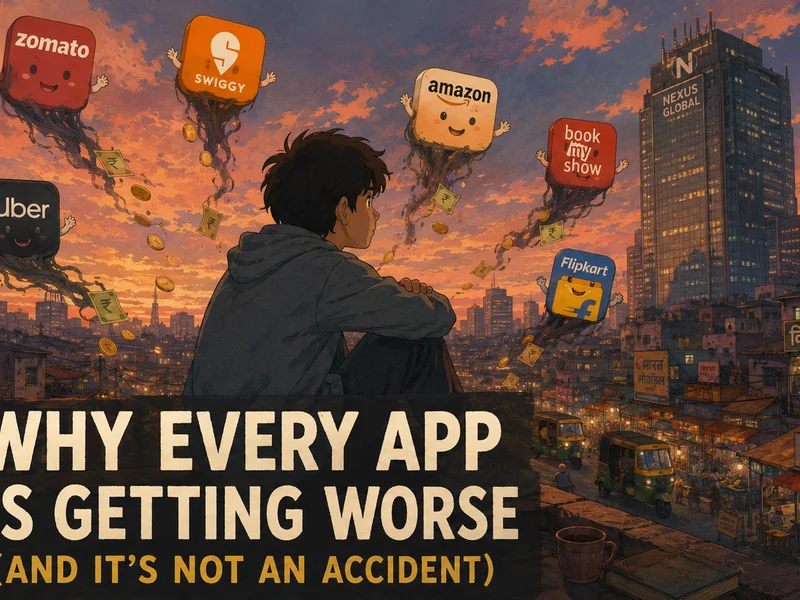
Yeah. That’s because there isn’t one. Zomato, Swiggy, Ola, Uber, Amazon, BookMyShow — they all got worse together. Which is weird if you think it’s a coincidence.
It’s not. There’s a word for it now.
Enshittification.
Cory Doctorow coined it in 2022. The American Dialect Society made it Word of the Year in 2023. It basically describes how platforms die: they start amazing, lock you in, then slowly turn into a pile of crap while extracting every rupee possible.
But in India? It happened at warp speed.
Apps don’t get worse by accident. They get worse in three deliberate stages — and India was the perfect lab because we’re a billion people with cheap data and barely any bargaining power.
Stage 1: Make the user happy
This is the free candy phase.
Urban Company used to send professional plumbers at rates that killed your local guy. Jio Cinema spent $3 billion on IPL digital rights and streamed the entire 2023 season completely free — no subscription, no paywall. The final drew 32 million concurrent viewers. A world record for any live-streamed event.
Hotstar did the same before Disney came in. Free cricket. Beautiful interface. Zero buffering.
They weren’t being nice. They were buying your habits.
Your “eating out” habit became “order on Zomato.” Your “walk to the kirana store” became “Blinkit it.” Your “call the auto guy” became “Uber it.” They burned investor money on every transaction just to make sure you’d forget the old way.
And it worked.
Stage 2: Sell your attention
Once you’re locked in, the real customer shows up.
And the real customer is not you. It’s the advertiser.
Amazon India now makes you scroll past sponsored results before seeing anything real. Their own internal documents and Reuters reports showed they artificially push house brands — Solimo, Amazon Basics — above better products. The CCI literally called this anti-competitive.
Flipkart’s ad revenue hit ₹6,317 crore in FY25. That’s 31% of their total revenue. Amazon, Flipkart and Myntra together made ₹15,573 crore just from ads.
They’re not retailers anymore. They’re media companies that also sell phones.
Truecaller is even more brutal. You installed it to block spam. But your entire contact list got uploaded to their servers — including people who never used the app. Now they have 350 million Indian users and most of their money comes from ads.
Guess who the advertisers are? Banks, insurance companies, telecom — the exact industries that spam you the most.
The spam fighter and the spam seller are the same app.
Let me be real. Your data is being sold back to you as targeted garbage.
Stage 3: Direct extraction
This is where they reach into your pocket.
Zomato’s platform fee was ₹2 in August 2023. It is ₹14.90 now. That’s a 645% increase in under three years. Swiggy is at ₹14.99.
Add delivery charges, packaging charges, small order fees, GST — your ₹200 biryani becomes ₹380 at checkout and you barely notice because they trained you to not look.
BookMyShow adds an “internet handling fee” that is technically questionable under RBI’s MDR guidelines. The Bombay High Court allowed convenience fees in 2025 for commercial services, which basically gave them a free pass. FY25? They made ₹828 crore just from online ticketing. A huge chunk is that handling fee you pay without thinking.
And the drivers? The delivery workers?
Ola and Uber drivers earn one-third of what they made in 2015. Platform commission went from 10% to 30%. Same hours. Same EMIs. Just way less pay.
Zomato and Swiggy delivery workers struck on New Year’s Eve 2025. Three lakh workers. Because the flexible hours and good wages they were promised? Never happened. The 10-minute delivery pressure is just extra.
So yeah. User gets squeezed. Restaurant gets squeezed. Worker gets squeezed.
Three-sided extraction.
The burn must lead to earn. Every rupee they spent “free” was investor money. And investors don’t do charity. They do extraction.
Here’s where I get opinionated.
I don’t think we accidentally fell into this.
We were targeted.
India is the most dangerous combination for platform capitalism: massive population, dirt-cheap internet, and low purchasing power. If you can learn to control consumer habits here, you can win anywhere. And they learned fast. While the US and Europe saw this decay over decades, we got the compressed version. We didn’t even get time to process it.
The local auto guy’s number? Deleted. The kirana store? Replaced by Blinkit. Cable TV? Replaced by Netflix. When all your options were killed, the extraction phase began.
But here’s what they don’t want you to know.
This system only works if you spend unconsciously. If you order without comparing. If you book without checking the fee breakdown. If you scroll past the sponsored tag.
Awareness is literally the only defense. We can’t rebuild the whole system tomorrow. But we can pause before every transaction and ask: is this actually worth it?
Maybe if enough of us stop being the product, we stop being treated like one.
FAQ
What is enshittification?
It’s a pattern where platforms get great, lock you in, then get worse on purpose while extracting more money. Coined by Cory Doctorow. Word of the Year in 2023. Very accurate, very depressing.
Why did Zomato’s platform fee increase so much?
Because they can. It started at ₹2 in 2023, now ₹14.90. Small hikes so you don’t rebel. At nearly 25 million monthly users, every ₹2 hike is massive revenue. It’s not about covering costs. It’s about unit economics.
Is BookMyShow’s convenience fee illegal?
Technically it conflicts with RBI MDR rules, but Bombay HC allowed convenience fees in 2025 for commercial services. So they charge it anyway. You’re paying it because you have no other choice.
Why are Uber/Ola drivers earning less?
Platform commission went from 10% to 30%. Same hours. Same EMIs. One-third the pay. The “flexible gig” promise was marketing. The reality is a debt trap.
Can we fix this?
Not quickly. But stop spending unconsciously. Compare. Check fees. Use alternatives when they exist. The system breaks if we stop being predictable.
Okay so.
That’s the whole scam. Your apps didn’t randomly get worse. They followed a playbook. And India was the perfect test case because we love a good deal and we hate reading terms and conditions.
PS: I still miss 2016 Jio. That shit was real. Byeeee!
Comments
Related Articles
Never miss an update
Join 50,000+ developers getting our weekly tech insights.