
The Bitter Truth Behind India’s Ethanol Revolution: What E20 is Secretly Costing You
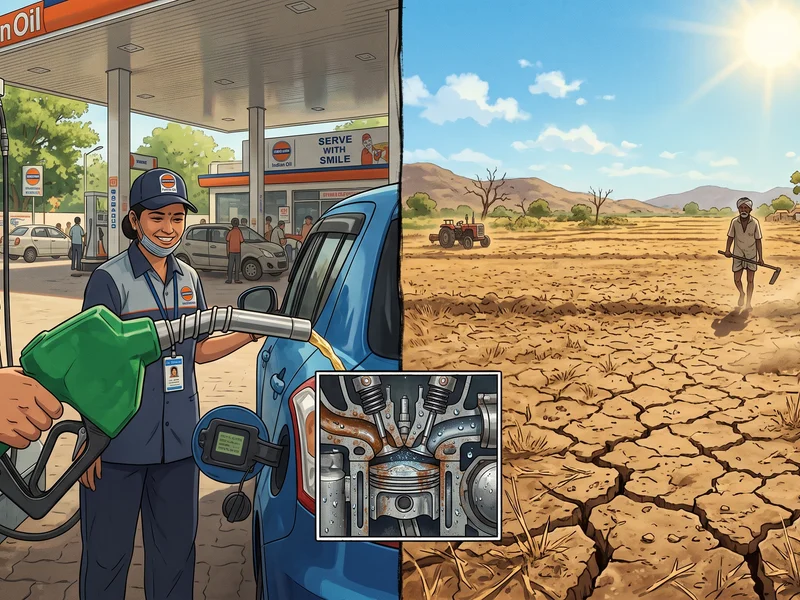
If your motorcycle has been idling uniquely rough lately, or if you’ve noticed your car’s mileage take an unexplainable dip, you aren’t imagining things. You are feeling the direct mechanical friction of a massive, top-down macroeconomic shift.
E20 fuel—a blend of 80% petrol and 20% ethanol—is now the mandatory default baseline across the country. The final element of consumer choice was removed when regular unblended petrol was quietly phased out at the pump. We are already moving toward even higher concentrations; flex-fuel stations dispensing E85 are rolling out in major metro areas, with plans to scale to 5,000 national outlets by late 2027.
On paper, this shift is framed as a triumph of green engineering and energy self-reliance. In reality, it is a complex economic trade-off. While the macro-level benefits to the state are undeniable, the micro-level costs are being paid directly out of the working-class pocket—and via a quietly mounting environmental crisis in our agricultural heartlands.
Let’s look past the polished press releases and look at what this transition actually costs your vehicle, your wallet, and our natural resources.
1. The Fast Track to Atmanirbharta: Bypassing the Original Roadmap
To understand the speed of this rollout, look at the brutal reality of India’s trade balance. India imports roughly 85% of its crude oil requirements. In the 2024–25 financial year alone, that oil bill totaled nearly $137 billion. Every time conflict flares up in West Asia or a shipping logjam gridlocks the Strait of Hormuz, the domestic economy feels an immediate inflationary shock.
The long-term structural solution to this exposure is electrification. With global battery pack prices dropping to record lows of roughly $108 per kilowatt-hour, the running costs of an electric vehicle in India are remarkably low—running close to ₹1 to ₹1.5 per kilometer, compared to well over ₹6 for a traditional internal combustion engine.
RUNNING COST COMPARISON (PER KM)
EV Running Cost:     ██ [₹1 - ₹1.5]
Petrol Running Cost: ████████████ [₹6+]
But you cannot electrify 260 million legacy two-wheelers overnight. Overhauling a continental fuel distribution infrastructure takes decades. To bridge this transition gap, the state turned to the Ethanol Blending Programme.
For nearly twenty years, the program crept forward at a crawl. Then in 2021, the policy timeline was dramatically accelerated. The original target of achieving a 20% ethanol blend by 2030 was pulled forward to 2025. India bypassed decades of developmental iterations in a multi-year sprint, prioritizing immediate crude offset over systemic readiness.
2. The Consumer Scorecard: Why Isn’t Your Fuel Getting Cheaper?
The state’s official scorecard for the ethanol rollout presents an undeniably impressive high-level picture:
- Foreign Exchange Savings: Over ₹1.84 lakh crore saved by offsetting crude imports.
- Carbon Mitigation: Approximately 909 lakh tonnes of carbon emissions avoided.
- Agrarian Capital: Well over ₹1.18 lakh crore funneled directly to domestic agricultural processors.
Structurally insourcing energy expenditure is a massive win for national resilience. But for the citizen standing at the pump paying over ₹103 per liter, the microeconomics tell a very different story.
THE MACRO VS. MICRO GAP
+------------------------------------+------------------------------------+
| WHAT THE STATE SAVED               | WHAT THE CONSUMER PAYS             |
+------------------------------------+------------------------------------+
| ✔ ₹1.84 Lakh Cr in Forex           | ✘ ₹103+/Litre (Pump Price Baseline)|
| ✔ 909 Lakh Tonnes of CO2 Cut       | ✘ ~5-7% Drop in Fuel Efficiency    |
| ✔ ₹1.18 Lakh Cr to Farm Sector     | ✘ Higher Cost Per Effective Km     |
+------------------------------------+------------------------------------+
Even though ethanol costs significantly less to produce domestically than imported crude oil, E20 petrol is priced exactly the same as legacy fuel. The NITI Aayog roadmap explicitly recommended offering consumer incentives by pricing ethanol blends cheaper to compensate for the lower energy density of the fuel. Ethanol contains roughly one-third less energy than pure gasoline; running an E20 blend results in a predictable 5% to 7% drop in fuel efficiency.
The Excise Duty Illusion
When public pushback mounted over high pump prices, the state highlighted an excise duty cut, framing it as a “revenue sacrifice” of nearly ₹1 lakh crore. However, historical context reveals a structural tax pattern:
- 2013: International crude sat at $105 a barrel. Petrol in India retailed around ₹70 per liter, with excise duty clamped at roughly ₹10.
- 2014–2015: Global crude prices crashed by half. Instead of passing those savings to consumers, the state absorbed the margin by hiking excise duties.
- 2020–2026: Crude prices fluctuated around $80 a barrel, yet domestic fuel prices climbed to all-time highs.
Returning a fraction of that tax cushion via structural duty cuts isn’t a government sacrifice; it is the reallocation of consumer capital. The state reaped the windfall during the crude market valleys, but the consumer is left holding the bill for the energy transition.
3. The Mechanics of Engine Decay: What E20 Does to Older Cars
The hidden cost of the ethanol push isn’t just found on your fuel receipt; it shows up under the hood. Ethanol is highly hygroscopic, meaning it actively attracts and absorbs moisture directly from the ambient air.
[Ambient Air Moisture] ---> Absorbed by Ethanol ---> [Water-Phase Separation]
                                                              |
                                                              v
                                             Corrosion of Metal Fuel Lines
                                             Degradation of Rubber Gaskets
                                             Fuel Pump Cavitation Failures
When fuel sits in a tank, the water bound to the ethanol can separate into a distinct layer at the bottom of the tank. This moisture induces rapid corrosion in classic metal fuel lines, clogs fuel injectors, and degrades the non-variant rubber gaskets, seals, and plastic fuel-system components found in older vehicles.
Every mass-market vehicle manufactured in India prior to 2023 was engineered strictly for E5 or E10 compliance. Forcing these legacy powerplants to run exclusively on E20 accelerates component wear.
The Insurance Trap
The mechanical risk quickly translates into a financial one. Major insurance entities originally flagged that running non-compatible legacy vehicles on high-blend fuels could be treated as consumer negligence. If a vehicle owner continues to use a mandatory fuel blend that their owner’s manual explicitly warns against, insurers can legally dispute claims for subsequent fuel-system failures.
While public pushback eventually forced insurers to clarify that basic comprehensive policies remain valid, the legal loophole remains open: component failures directly caused by fuel incompatibility are rarely covered under standard mechanical breakdown warranties. The consumer is left exposed, with no alternative fuel choice at the station.
4. The Corporate & Regulatory Shadow: The Transparency Cascade
The acceleration of this transition was heavily driven by the Ministry of Road Transport and Highways. Pulling the E20 timeline forward by five years successfully forced market alignment, but this speed has drawn sharp critiques regarding corporate overlap and corporate governance.
Public scrutiny intensified when independent tracking highlighted the financials of agricultural processing and ethanol supply entities connected to political insiders. For instance, Cian Agro, a major ethanol supplier linked to family networks of high-ranking ministry leadership, saw an exceptional growth trajectory.
CIAN AGRO REVENUE TRAJECTORY
June 2024: ██ [₹18 Crore]
June 2025: ███████████████████████████████████ [₹523 Crore]
*Stock appreciation over the same period: ~2,000%
In June 2024, Cian Agro reported modest quarterly revenues of roughly ₹18 crore. By June 2025, matching the sharp acceleration of the state’s ethanol mandate, the company’s quarterly revenue skyrocketed to ₹523 crore—an exceptional growth trajectory mirrored by a 2,000% appreciation in its public equity valuation.
Ministry leadership has consistently denied any wrongdoing or conflict of interest, stating that connected enterprises account for less than half a percent of the total national ethanol supply chain. They clarified that tender allocations are handled independently by the Ministry of Petroleum and Natural Gas, while pricing metrics are governed directly by the Cabinet.
Without a formal regulatory investigation, these timelines can be interpreted as mere coincidence. However, the system’s lack of transparency continues to impact public trust. When public interest advocates filed Right to Information (RTI) requests seeking the disclosure of the Automotive Research Association of India (ARAI) safety and engine wear studies used to validate the safety of E20 on legacy fleets, the requests were denied. The state cited “confidential trade secrets.”
True public policy alignment requires absolute transparency. When safety data is classified as a proprietary secret and public questioning is deflected with “straw man” arguments, the line between public interest and private enterprise becomes blurred.
5. The Ecological Bill: How Fuel Independence Mutates into a Water Crisis
The foundational promise of India’s bio-fuel strategy was built on Second-Generation (2G) Ethanol—brewing fuel cleanly from agricultural waste, crop residues, and the stubborn paddy straw that farmers burn every winter. This approach would bypass the food-versus-fuel dilemma entirely, avoiding any new demand on arable land or fresh water.
Instead, the 2G rollout has largely stalled. Flagship refineries have consistently operated well below planned capacity due to complex raw material collection logistics. To hit the accelerated E20 target early, the state pivoted back to First-Generation (1G) food feedstocks: Sugarcane, Maize, and Rice.
This choice carries a severe environmental cost:
WATER REQUIRED TO PRODUCE 1 LITRE OF ETHANOL
Sugarcane: ████ [3,500 Liters]
Maize:     █████ [4,500 Liters]
Rice:      ████████████ [10,000 Liters]
The Agricultural Domino Effect
- Sugarcane: Manufacturing a single liter of sugarcane-derived ethanol consumes over 3,500 liters of water. Most sugarcane cultivation is concentrated in Uttar Pradesh and Maharashtra—regions already dealing with structural groundwater depletion. In fact, the water required to grow India’s current sugarcane crop volume is roughly equivalent to draining an entire major reservoir, like the Ganga Sagar dam, every single year.
- Maize: The state aggressively incentivized a shift toward maize, which now supplies nearly half of India’s ethanol distilleries. Producing a liter of ethanol from maize demands roughly 4,500 liters of water. As distilleries scaled up demand, wholesale maize prices surged from ₹15,000 to ₹25,000 per tonne. This market distortion has flipped India from a net exporter of maize to an importer. Because 60% of domestic maize historically supplied poultry and cattle feed, the price of eggs, chicken, and milk has seen direct inflationary pressure.
- Rice: The most concerning element of the feedstock strategy involves food security allocation. The Food Corporation of India (FCI) handles grain stockpiles bought with public funds to safeguard food security for vulnerable communities. Distilleries are now purchasing broken food-grade rice from these stocks. Broken rice historically made up roughly 25% of the free rations distributed to nearly 80 crore low-income citizens. The current policy framework scales that allocation down to 10%, diverting the remaining volume to ethanol distilleries. Transforming that food grain into fuel requires an astonishing 10,000 liters of water per liter of ethanol.
The Rise of the “Water Wives”
The human cost of this groundwater depletion is visible in rural Maharashtra. In water-stressed villages like Denganmal, severe water scarcity has shaped a complex social phenomenon known as “Water Wives” (Paani Bai).
With local wells completely dried up by industrial sugarcane cultivation and falling water tables, men frequently marry a second or third wife—often vulnerable widows or single mothers—solely to have someone walk hours to distant water sources to fetch water for the household. Our race for energy self-reliance is accelerating an environmental crisis that deeply impacts these communities.
6. Tactical Consumer Protection: Navigating the Flex-Fuel Era
The structural shift to high-blend fuels is here to stay, and the consumer choice has been taken away. However, there are proactive operational steps you can take to protect your assets and vehicle from fuel mismanagement.
Operational Vehicle Protection
- Run Fuel Stabilizers: If you own a pre-2023 vehicle that sits idle for more than two weeks, add an aftermarket ethanol fuel stabilizer to the tank. These additives prevent phase separation and reduce moisture absorption.
- Inspect Fuel System Components: Instruct your mechanic to inspect your fuel lines, filters, and rubber gaskets at every service interval. Replacing a degrading rubber seal proactively costs pennies compared to replacing a seized fuel pump.
- Avoid Long-Term Fuel Storage: Try not to leave high-blend ethanol fuel sitting in a vehicle tank for months at a time. Run the tank low before periods of storage to minimize moisture accumulation.
Administrative & Financial Protection
- Get Insurance Clarifications in Writing: Do not rely on verbal assurances or generic press statements. Send a formal email to your current motor insurance provider asking a direct question: “Is mechanical damage arising from the mandatory use of government-mandated E20 fuel fully covered under my policy?” Save their written confirmation.
- Document Every Maintenance Expense: Keep detailed records of all fuel-system repairs, parts receipts, and diagnostic notes. If public policy eventually pivots to offer vehicle retrofitting subsidies or consumer relief programs, you will need a clear paper trail.
- Verify Compatibility Before Buying Used: If you are shopping for a pre-owned vehicle, double-check the manufacturing year. Avoid buying pre-2023 assets unless you are prepared to cover accelerated fuel-system maintenance.
Key Takeaways
- The Mandate is Absolute: As of 2026, legacy unblended petrol has been phased out across India. E20 is the mandatory baseline fuel, with E85 expanding rapidly.
- Efficiency Losses: Ethanol contains less energy density than pure petrol. Running E20 brings a structural 5% to 7% reduction in fuel economy, meaning consumers are paying the same price per liter for fewer effective kilometers.
- Mechanical Incompatibility: Pre-2023 vehicles are not engineered to handle the corrosive, hygroscopic nature of 20% ethanol blends, which can accelerate the wear of rubber gaskets and metal lines.
- Food vs. Fuel Bottlenecks: Diverting maize and rice feedstocks to energy distilleries has driven up the cost of cattle feed, contributing to inflation in food staples like eggs and dairy.
- Severe Groundwater Depletion: Transforming water-intensive crops into ethanol requires thousands of liters of water per liter of fuel, accelerating an environmental crisis in regions like rural Maharashtra.
Frequently Asked Questions
Q1: Can I still buy normal, unblended petrol in India?
A: No. The transition timeline moved regular petrol off the market. E20 fuel is now the default standard across the station network, with higher flex-fuel options like E85 arriving in major urban centers.
Q2: Will using E20 fuel void my older car’s manufacturer warranty?
A: For vehicles built before 2023, standard factory warranties typically covered fuel blends up to E10. While standard third-party insurance policies remain legally valid for accidents, internal component damage caused directly by fuel incompatibility is generally not covered by manufacturers or extended warranties.
Q3: How much mileage loss should I expect with E20 petrol?
A: Due to ethanol’s lower energy density compared to pure gasoline, you will experience a predictable 5% to 7% reduction in overall fuel efficiency.
Q4: Why doesn’t the government price E20 cheaper than regular petrol?
A: The government currently maintains high excise duties to offset infrastructure costs and protect state revenues, using the savings to improve the trade balance rather than offering direct price cuts at the pump.
Q5: What crops are used for India’s ethanol production?
A: While the initial plan focused on crop waste (2G ethanol), production currently relies on food grains and water-intensive crops like sugarcane, maize, and broken food-grade rice from state reserves.
Comments
Related Articles

Never miss an update
Join 50,000+ developers getting our weekly tech insights.