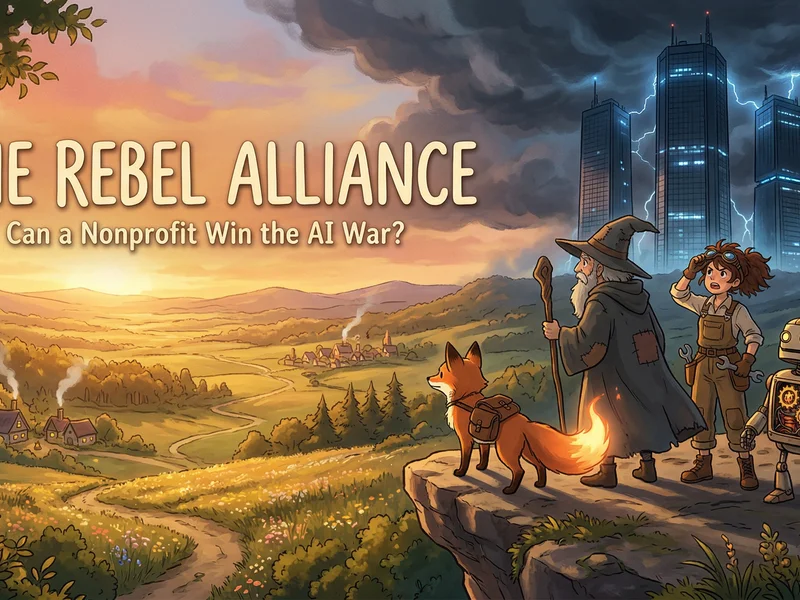
Mozilla's Rebel Alliance: Can a Nonprofit Win the AI War?

- What Is Mozilla.ai, Exactly?
- Why This Moment Is Different
- How the Organization Actually Works
- The “Regularizer”: How Bylaws Become Ethics Enforcement
- What’s Actually Happening Right Now
- The Lazy Narrative Is Wrong
- What Mozilla.ai Is Actually Building
- The Honest Take: Can VC Money Ever Stay Pure?
- FAQ
- Where This Leaves Us
OpenAI started as a nonprofit and ended up worth $500 billion. Mozilla watched that happen and apparently thought: we need to do this differently — legally differently. So they built a legal structure specifically designed to stop their own CEO from going to jail for choosing privacy over profit.
That’s not a metaphor. That’s actually how Mozilla.ai’s CEO, John Dickerson, describes it.
What Is Mozilla.ai, Exactly?
Mozilla.ai is a Public Benefit Corporation — a VC-backable, equity-granting startup — with one unusual twist: about 80% of it is owned by Mozilla’s nonprofit parent, while employees hold the remaining 20% through a stock option plan. It’s designed to raise traditional venture capital while being legally bound, through its own bylaws, to prioritize privacy, decentralization, and data ownership alongside revenue.
In short: it’s a startup built to resist the pressures that turned other mission-driven AI companies into what they were originally fighting against.
Why This Moment Is Different
Here’s the thing that makes the timing almost poetic. OpenAI was founded as a nonprofit in 2015. It completed its full for-profit recapitalization in October 2025 — the same year Mozilla was restructuring itself in the opposite direction. Anthropic, which was founded by OpenAI defectors over safety disagreements, now has a $350 billion valuation and faces Trump administration criticism for being too restrictive with its AI.
The dominant narrative in AI — build it big, raise billions, figure out the ethics later — has already produced two of the most powerful AI companies in the world. Mozilla’s bet is that there’s a third path, and that the window to build it is closing fast.
Mozilla president Mark Surman told CNBC in January 2026: “For many people, the idea that open-source AI can win, or this rebel alliance, that those players can actually take a piece of the market — they find it hard to believe. But there’s a bunch of trends that are underway.”
How the Organization Actually Works
Most coverage treats Mozilla as “the Firefox company.” But Mozilla has quietly reorganized itself into a portfolio of companies, all owned by Mozilla.org — the nonprofit at the top.
Here’s how the portfolio breaks down:
- Mozilla Corporation — Firefox, the browser
- MZLA Technologies — Thunderbird, the email client
- Mozilla.ai — the AI startup (the subject of this article)
- Mozilla Ventures — the VC arm, which has invested in 55+ companies
- Mozilla Data Collaborative — a newer entity based in the UK
Each entity can operate with a different business model, take different types of money, and pursue different revenue strategies. That flexibility is the whole point. As Mozilla CTO Rafi Krikorian put it in a recent interview: “This gives us opportunities in the future for other people to join us in this mission.”
Mozilla.ai specifically sits in an interesting position within this portfolio. The nonprofit owns roughly 80%, with employees holding 20% through an employee stock option plan — notably the first time Mozilla has offered equity to employees. And a Series A fundraising round is expected in 2026, which will bring in external venture capital.
The “Regularizer”: How Bylaws Become Ethics Enforcement
This is the part that most coverage completely misses.
In a traditional C-Corp or S-Corp, the CEO has a fiduciary duty to shareholders. That legally means maximizing financial returns — full stop. If you’re the CEO of a C-Corp and you turn down a profitable deal because it violates your values, your shareholders can potentially sue you.
A Public Benefit Corporation changes that. It adds what Dickerson calls a “double bottom line” — a second term in the objective function. In practical terms, Mozilla.ai’s bylaws encode its social mission (privacy, openness, decentralization) as a legal constraint on executive decision-making. The CEO won’t face liability for choosing the mission-aligned path over the more profitable one.
Dickerson frames it almost like an optimization problem: if you’re a machine learning person, think of it as revenue maximization plus a lambda-weighted social mission term. Or think of it as constrained optimization — maximize revenue, subject to hard constraints around privacy and user sovereignty.
And honestly? That framing matters more than it sounds. The reason most “values-driven” tech companies eventually drift is that there’s no legal teeth behind the values. When the board pressure comes, the mission yields because it has to. A PBC creates a situation where the mission doesn’t have to yield — it’s in the bylaws.
This is the real innovation at Mozilla, and it’s getting almost zero attention in the broader AI discourse.
What’s Actually Happening Right Now
Two major things landed in late 2025 and early 2026 that brought Mozilla’s AI strategy into sharp focus.
The rebel alliance announcement. In January 2026, Mozilla committed its entire $1.4 billion in reserves to funding what Surman calls a “rebel alliance” — a loose network of startups, developers, and public interest technologists building open-source alternatives to proprietary AI. Through Mozilla Ventures, the organization has already backed over 55 companies, including Oumi (open-source agent platform), Transformer Lab (open-source model training tools), and Trail (AI governance for regulated enterprises). The financial mismatch is staggering: OpenAI has raised $60B+, Anthropic $30B+. Mozilla is fighting with $1.4B. But they’ve been here before.
The Firefox AI backlash. In December 2025, new Mozilla Corp. CEO Anthony Enzor-DeMeo announced Firefox would evolve into a “modern AI browser.” The community didn’t love it. One viral tweet read: “I’ve never seen a company so astoundingly out of touch with the people who want to use its software.” Another: “I switched to Firefox because it was the last AI-free browser.” A nixCraft post on X about Mozilla’s disconnect with its users racked up over 37,000 likes.
Mozilla responded with a promise: an “AI kill switch” coming in Q1 2026 that would completely disable all AI features — permanently, if users choose. Mozilla developer Jake Archibald confirmed via Mastodon: “The kill switch will completely remove all these things and never show them again in the future.” The optics remain imperfect (it’s opt-out, not opt-in), but it’s a more decisive response than most companies give to community feedback.
The tension here is real and worth sitting with. Mozilla needs revenue. Firefox currently holds around 3–4% desktop market share, and somewhere between 80–90% of Mozilla’s revenue comes from its Google search deal. AI features represent a genuine diversification opportunity. The community wants no AI. Mozilla wants both mission and money. A PBC structure helps with the first problem; the second is still a negotiation.
The Lazy Narrative Is Wrong
Most coverage positions Mozilla as outgunned and outclassed — a well-meaning nonprofit that’s too late, too small, and too slow to matter in AI. And in raw capital terms, that’s true.
But here’s what that take misses.
The small model thesis. Mozilla.ai isn’t trying to build GPT-5. They’re betting on a future where thousands of small, specialized, open-source language models — running locally, on edge devices, in private enterprise environments — outperform centralized giants at lower cost, lower latency, and dramatically lower privacy risk. Dickerson made a compelling point: if 2026 produces a world where choosing between 10,000 small models achieves parity with a frontier model, Mozilla’s “choice-first stack” becomes the infrastructure that makes that world navigable.
The enterprise open-source signal. Security company Wiz published research in early 2025 showing that among their customers’ hosted AI solutions, 8 of the top 10 most-used tools were open-source or open-source adjacent. If you go down to the top 35, 60% are open-source. The noise is around OpenAI. The actual enterprise deployment is happening with open tools. [INTERNAL LINK: Enterprise AI adoption trends and open-source tools]
The browser precedent. Mozilla’s Firefox helped break Internet Explorer’s monopoly in the early 2000s. Not by outspending Microsoft. By building something better, open, and trust-aligned, and waiting for the market to mature. The AI industry is still very early in its consolidation phase. Mozilla has done this movie before.
What Mozilla.ai Is Actually Building
Mozilla.ai under Dickerson is a lean team of ~25 people (targeting ~30 by mid-2026) focused on developer tooling and what they’re calling the “choice-first stack” — essentially a LAMP stack equivalent for open-source AI.
The key components:
- any-llm — a single Python interface to call OpenAI, Claude, Mistral, local models, or anything else, without being locked to any provider. As of February 2026, it now also works in Go.
- any-agent — a unified interface for building and testing AI agents across different frameworks
- any-guardrail — governance and safety tooling across model providers
- llama file / encoder file — portable, efficient, deterministic wrappers for running ML models locally, including on edge devices
- MCPD — a curated registry of Model Context Protocol servers, launched to address trust issues in the rapidly growing MCP ecosystem
- Lumigator — an evaluation platform for comparing and selecting AI models
- Blueprints — templates for building open-source AI applications
The design philosophy is consistent: make open-source AI as easy to use as the OpenAI API. Right now, if a developer wants to experiment with AI, they use pip install openai and one line of Python. Mozilla wants to match that simplicity across the entire open-source stack.
They also recently launched integrations with JupyterLite, LangChain, and Headroom — showing that the ecosystem play is starting to take shape.
For the broader picture: Mozilla.ai is not building the intelligence. It’s building the plumbing that makes open intelligence accessible, portable, auditable, and safe. [INTERNAL LINK: What is the Model Context Protocol (MCP)?]
The Honest Take: Can VC Money Ever Stay Pure?
Let me be direct about the tension here, because it’s real.
The history of mission-driven tech organizations taking outside capital is… not inspiring. OpenAI is the canonical example. But you also have cases like Mozilla itself — deeply dependent on Google search revenue to fund its privacy advocacy, which is an irony that doesn’t go unnoticed by critics.
The PBC structure is the most sophisticated legal attempt yet to solve this problem. It’s better than nothing. But bylaws are only as strong as the board that enforces them. VC investors, even patient ones, eventually want returns. “Lambda times social mission” is a nice framing, but when Series B pressure arrives, lambdas tend to shrink.
What’s different at Mozilla.ai is the 80% ownership stake by the nonprofit parent. If the mission is getting diluted, Mozilla.org has the votes to notice and act. That’s a real structural backstop. Whether it’ll actually be used in a high-stakes moment — no one knows yet, because that moment hasn’t arrived.
Mozilla.ai CEO John Dickerson’s track record at ArthurAI (fairness and observability, open by design) suggests he’s genuinely committed. But the test of any commitment is what happens when commitment gets expensive.
FAQ
What is Mozilla’s rebel alliance in AI? It’s a loose coalition of startups, developers, and nonprofits that Mozilla is funding through Mozilla Ventures — all building open-source, privacy-preserving alternatives to proprietary AI systems like OpenAI and Anthropic. Mozilla has committed its full $1.4 billion reserve to this effort.
Is Mozilla.ai raising venture capital? Yes. As of early 2026, Mozilla.ai CEO John Dickerson confirmed plans to raise a Series A. The company currently operates with ~$30 million in initial funding from the Mozilla Foundation and has around 25 employees.
What does “Public Benefit Corporation” mean for Mozilla.ai? It means Mozilla.ai is structured like a startup (can raise VC, issue equity, pursue revenue), but its bylaws legally require it to weigh a social mission alongside financial returns. Directors can’t be sued for choosing privacy over profit when those choices are consistent with the PBC’s stated mission.
Will Firefox remove AI features if I don’t want them? Mozilla has committed to an “AI kill switch” that would completely disable all AI features in Firefox. It was promised for Q1 2026. The functionality removes all AI UI and prevents future reintroduction — though independent browser Waterfox has criticized the approach as insufficient if underlying AI infrastructure remains in the codebase.
Can open-source AI actually compete with GPT-5 and Claude? Mozilla.ai’s thesis is that a world of thousands of small, specialized, locally-runnable models can achieve parity or better performance than large frontier models for most tasks — at lower cost, lower latency, and with full data ownership. The Wiz enterprise research (early 2025) showed that 60%+ of real enterprise AI deployments already use open-source tools.
What is the “LAMP stack for AI” concept? Coined by Mozilla CTO Rafi Krikorian, it’s the idea that open-source AI needs the same developer experience that LAMP (Linux, Apache, MySQL, PHP) gave early web developers — a standardized, composable, easy-to-assemble stack that removes the friction of choosing between dozens of incompatible tools. Mozilla.ai’s “choice-first stack” is the working implementation of this concept.
Where This Leaves Us
The AI industry is at a consolidation inflection point. A few mega-companies are racing to become the intelligence layer of the internet — and if they succeed, that layer will be closed, proprietary, and accountable to shareholders rather than users.
Mozilla’s bet is that this isn’t inevitable. The PBC structure, the 80/20 ownership split, the choice-first dev stack, the rebel alliance funding — none of it is guaranteed to work. But it’s the most architecturally serious attempt to solve the “mission vs. money” problem that AI has yet produced.
If you care about who controls the intelligence layer of the internet — and you should — Mozilla’s move is worth watching closely. Not because it’s certain to win, but because how it navigates the next two years will tell us a lot about whether “trustworthy AI” is a real category or just a marketing claim.
Sources: Transcript of interview with Rafi Krikorian (Mozilla CTO) and John Dickerson (Mozilla.ai CEO); CNBC (January 27, 2026); SiliconANGLE (August 22, 2025); Futurism (December 27, 2025); Heise Online (December 20, 2025); TechTarget (August 20, 2025); Stack Overflow Podcast (October 21, 2025); The Verge (December 16, 2025); Mozilla.ai blog.
Comments
Related Articles

Never miss an update
Join 50,000+ developers getting our weekly tech insights.