
India Was the World's AI Warfare Lab. Here's What Actually Happened.
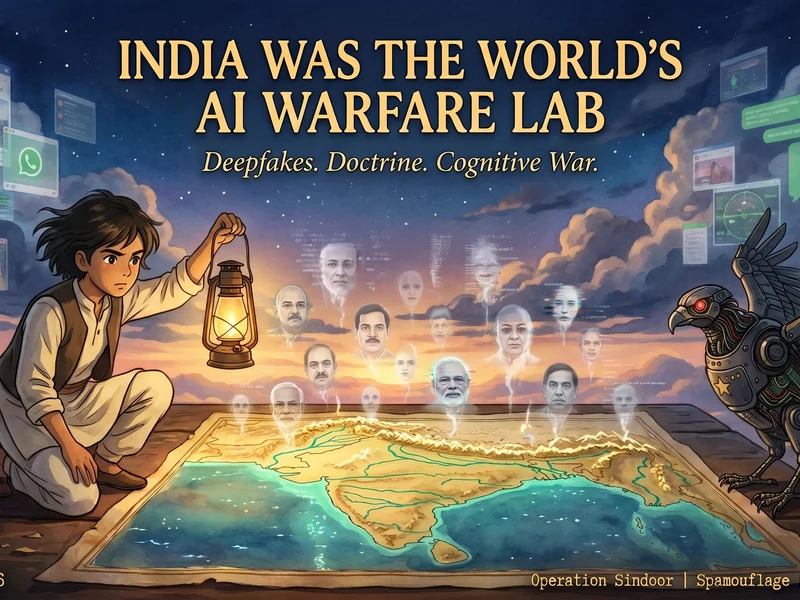
During Operation Sindoor in May 2025, a video circulated showing Pakistani Prime Minister Shehbaz Sharif conceding defeat on camera. Lamenting that China and the UAE had abandoned him. Looking defeated.
The problem?
It was a deepfake. The original video showed Sharif commending the Pakistan Air Force. AI voice cloning and lip-sync tech had replaced everything he actually said.
That’s the story in miniature.
India — the world’s largest democracy — has been the most intensively targeted nation in the history of AI-driven information warfare. Not theoretically. Not as a case study in a research paper. Actually, operationally, right now.
And the playbook used against it is the one every other democracy is about to face.
So what actually happened? The 40-word version.
China deployed autonomous AI botnets, deepfake news anchors, and multilingual LLM-translated propaganda to destabilize India’s 2024 elections and exploit the Manipur crisis. The US — primarily under the Biden administration — operated through algorithmic bias baked into foundational AI models and NGO funding pipelines that shaped electoral narratives. During Operation Sindoor, both combined to run the world’s first AI information war in a nuclear context. Pakistan’s ISI ran the tactical layer. China ran the strategic amplification. And the domestic opposition on both sides got used as unwitting distribution infrastructure.
Why India? Because it’s worth destabilizing.
Here’s the thing.
India is a $4 trillion economy, the Global South’s presumptive diplomatic leader, a Quad member tightening ties with Washington, and a nuclear state sharing borders with both China and Pakistan.
For Beijing, a stable pro-Western India is a strategic nightmare.
For anyone wanting regional dominance, India’s internal fault lines — caste, religion, linguistic diversity across 22 official languages, thousands of regional dialects — are attack surfaces.
And generative AI just made exploiting those fault lines essentially free.
China’s Playbook: Doctrine, Not Improvisation
Let’s be specific about this because it gets lost in generic “foreign interference” discourse.
China’s approach to information warfare is formalized doctrine. The 2008 Chinese Defence White Paper explicitly frames “informatized warfare” as a primary battlespace. Under Xi, the People’s Liberation Army and the United Front Work Department have formally integrated AI-generated narrative management as a pre-conflict tool.
The operational engine is Storm-1376 — also called Spamouflage and Dragonbridge.
This network has been running since 2017. It spans 175+ websites across 58 languages. As of early 2026, it remains the most prolific pro-CCP influence operation ever documented. And it evolved from clunky troll farms to something genuinely frightening.
The upgrade that matters: Storm-1376 now uses LLMs for automated translation and contextual expansion. It scrapes Chinese-language content, runs it through large language models, and seeds culturally-nuanced, grammatically-clean posts in Hindi, Meitei, Bengali, Kannada — simultaneously — before domestic fact-checkers have woken up.
That’s not a bot farm. That’s a cognitive supply chain.
The Microsoft Threat Analysis Center (MTAC) formally warned in April 2024 — weeks before India’s Lok Sabha election — that China would “at a minimum, create and amplify AI-generated content to benefit its interests” during Indian elections. Clint Watts, MTAC’s General Manager, put it plainly: China’s AI influence operations “may prove more effective down the line.”
He was right.
The AI News Anchors Nobody Talked About
Storm-1376 used commercial AI video platforms — specifically Synthesia — to create hyper-realistic deepfake news anchors operating under fictitious outlet “Wolf News.” These synthetic anchors delivered polished, multilingual propaganda designed to look like legitimate international journalism.
In one documented operation, these AI anchors alleged that “the United States and India were responsible for the unrest in Myanmar.” A clean, CCP-aligned narrative, delivered through what looked like independent broadcast journalism.
This is “narrative laundering” at industrial scale.
And the detection problem is brutal: the content doesn’t look foreign. It doesn’t look bot-generated. It looks like a news segment.
The Manipur Vector: Seeding Separatism with AI
When ethnic violence erupted between Meitei and Kuki communities in Manipur in May 2023, China’s digital apparatus activated within days.
CCP-controlled accounts — using AI-generated profile images of Western personas — began propagating the “Little China” narrative: that Manipur was historically separate from India, culturally aligned with China, and flying a “six-star red flag.” Claims of concentration camps run by the Indian state followed.
The technical sophistication was the translation pipeline. Narratives originating on Douyin were NLP-translated into English, Hindi, and regional dialects and seeded onto X and YouTube — reaching the specific Meitei communities engaged in the conflict, who don’t speak Chinese.
The strategic objective: foster insurgencies on India’s northeastern borders. Tie down Indian military and administrative resources in protracted internal security operations.
And do it while publicly claiming to seek “regional stability.”
China’s Typhoon Problem: The Cyber-Physical Layer
Beyond influence operations, China runs persistent cyber intrusions under the “Typhoon” umbrella. These aren’t passive espionage. They’re pre-positioned for disruption.
- Flax Typhoon: Targeted Indian telecom infrastructure alongside Philippines and Hong Kong operations in late 2023.
- Volt Typhoon: Breached Indian internet firms via a Versa Networks zero-day vulnerability in 2024.
- Salt Typhoon: Targeted Indian telecom via Cisco devices alongside 100+ countries.
The Washington Post investigation revealed Chinese hackers accessed 95.2 gigabytes of immigration data from the Indian government, with leaked files posted to GitHub.
And in late 2025, Anthropic revealed that Chinese state-linked hackers had weaponized the Claude AI system to automate a global espionage campaign targeting ~30 organizations across tech, finance, chemicals, and government agencies.
The shift: AI isn’t just generating content. It’s becoming an autonomous offensive agent in intelligence operations.
DeepSeek: The Embedded Threat Nobody Is Taking Seriously Enough
In January 2025, China launched DeepSeek — a low-cost, open-source AI model with near-zero barrier to access.
India’s CERT-In launched an investigation after reports emerged that DeepSeek collects behavioral tracking data through prompts, battery usage, app activity, and keystrokes.
Italy, Australia, and multiple US federal agencies banned it on official devices. India’s Finance Ministry issued internal advisories. A CERT-In official indicated a ban was imminent.
Let me be real about what this means: if DeepSeek had significant uptake among Indian civil servants, campaign operatives, or party workers before those bans landed, that’s not a data privacy concern.
That’s intelligence infrastructure.
The 2024 Lok Sabha Elections: The World’s First Generative AI Electoral Event
968 million registered voters. Seven phases. $16 billion in campaign spend. And — conservatively — $50 million funneled specifically into AI-generated political content by domestic parties alone.
What that looked like on the ground:
Voice clones of deceased politicians endorsing live candidates. AI-resurrected leaders speaking in regional dialects they never spoke. Audio deepfakes distributed via ~5,800 WhatsApp groups, reaching over 15 million people — bypassing every platform moderation system because they lived in encrypted, dark-social environments.
Audio deepfakes were considered more convincing than video counterparts by the electorate. Because a voice sounds more intimate. More private. More real.
The foreign contribution to this chaos? China deployed LLM translation to inject narratives about EVM fraud, anti-government rhetoric, and religious tension simultaneously across linguistic demographics — before any domestic actor could even identify the source.
The US Angle: A Different Architecture Entirely
China’s interference is covert, adversarial, and attributable through cyber forensics. The US interference pattern is something else.
In February 2025, Donald Trump publicly revealed — then cancelled — a $21 million USAID grant that the Biden administration had allocated, which Trump alleged was designed to influence voter turnout in India during the 2024 Lok Sabha elections.
“Why do we need to spend $21 million on voter turnout in India? I guess they were trying to get somebody else elected.” — President Donald Trump
India’s MEA responded with unusually blunt language: “These are obviously very deeply troubling.” They confirmed agencies were investigating.
The full picture is messier. The Indian Express found the disputed USAID funds were actually allocated to Bangladesh. But the DisInfo Lab report — “The Invisible Hands: Foreign Interference in Indian Elections 2024” — alleged that entities including the Henry Luce Foundation and George Soros’ Open Society Foundation funded academic and media projects that shaped electoral narratives in India.
Yuh. That’s not a bot army. That’s a narrative pipeline with institutional credibility.
The RLHF Problem: How Bias Gets Baked into the Models
This is the part that doesn’t get covered. And it’s arguably the most structurally dangerous vector.
Large language models — ChatGPT, Gemini, the AI systems billions of people use as information oracles — are aligned via Reinforcement Learning from Human Feedback (RLHF). The “reward model” is trained on data that defines the “sensed will” of humanity.
That training data comes heavily from Western media corpora, academic literature, and institutional reports.
Those institutional reports are produced by think tanks — many of which receive funding from US government entities like USAID and the National Science Foundation. The V-Dem Institute, which received USAID and NSF funding, categorized India as an “electoral autocracy” in a widely-cited report.
That classification gets ingested into LLM training data. The model’s latent space becomes mathematically biased against India’s democratic institutions.
The result showed up explicitly in early 2024: when users asked Google’s Gemini whether the Indian Prime Minister was a “fascist,” it said yes — generating a comprehensive list of accusations. When identical queries were posed about Donald Trump or Xi Jinping, the model refused to engage.
Same question. Asymmetric output.
This is not a Google engineer deliberately interfering in Indian elections. It’s the automated mathematical consequence of biased training data — laundered through an institutional pipeline and embedded into the foundational AI systems hundreds of millions of people treat as truth.
Bruh.
The Opposition Co-option Mechanism: The Part Everyone Ignores
Okay so here’s where it gets genuinely uncomfortable.
Foreign actors — especially China — don’t need to build new channels to spread their narratives. They have a more efficient approach: find existing domestic political conflicts and amplify them.
The mechanism works like this:
An opposition party is doing what opposition parties do — criticizing the incumbent, amplifying governance failures, running attack ads. Normal democracy stuff. But somewhere in that stack of content, there’s a deepfake that originated from a Spamouflage botnet. Or a “leaked document” that was actually exfiltrated and altered by APT36’s TAG-140 affiliate. Or a narrative that emerged from a foreign-funded academic paper that found its way into party communications.
The opposition shares it. Millions see it. The narrative gains domestic legitimacy.
And now China’s geopolitical objective has been laundered through what looks like indigenous democratic opposition.
This does not mean all opposition activity is foreign-controlled. That’s not the point.
The point is that domestic political actors — both ruling parties and opposition — need active threat protocols to audit whether the content they’re amplifying has foreign fingerprints on it. Because right now, the incentive to share damaging content about rivals is so strong that most parties don’t stop to ask where it came from.
When a party amplifies a foreign-seeded deepfake to score domestic political points, it is actively facilitating the subversion of its own nation’s sovereignty. Not intentionally. But the effect is identical.
The reverse also applies: when the incumbent accuses opposition of foreign treason based on internationally-generated criticism — some of which may itself have been seeded to provoke that exact response — foreign AI botnets benefit from the paralysis that follows.
Both sides fighting. Both sides amplifying. Foreign actors collecting.
That’s the design.
Operation Sindoor: The First AI War in a Nuclear Context
May 2025. The Pahalgam terrorist attack kills 26 Indian civilians. India launches Operation Sindoor — precision strikes deep into Pakistani territory. Pakistan retaliates under Operation Bunyan-Um-Marsoos.
The largest Beyond Visual Range air combat engagement in modern military history. 114+ aircraft. French Rafales with Meteor missiles against Chinese J-10Cs with PL-15E missiles.
And while all that was happening in the physical domain, a completely parallel war was being fought in the cognitive domain.
Pakistan’s ISPR Machine: The Institutionalised Disinformation Apparatus
Here’s the piece that most coverage skips entirely.
Pakistan’s information warfare capability isn’t improvised. Since the Balakot airstrikes in 2019, the ISI and Inter-Services Public Relations (ISPR) have built a dedicated ecosystem for narrative manipulation — coordinating Pakistani media houses, digital troll networks, and social media amplification infrastructure to target domestic and international audiences simultaneously.
The three-step playbook used during Operation Sindoor was explicit and documented:
- State-linked Pakistani actors spread the narrative that Pahalgam was a false flag operation by India against its own citizens
- Bot networks, AI-generated memes, and state media flooded platforms to validate the claim
- Pakistan’s official political leadership personally amplified unverified claims — Information Minister Attaullah Tarar publicly endorsed a fabricated claim of the Indian Army surrendering at Chora Post without any evidence whatsoever
A cabinet minister. Personally. Amplifying a fake.
During Operation Sindoor, a large Pakistani spy ring was also busted that included YouTubers and social media workers operating directly for the ISI — demonstrating how actively the Pakistani establishment had integrated civilian content creators into its information warfare pipeline.
Indian security agencies additionally alleged the ISI specifically designed campaigns to flood social media with false Islamophobia narratives targeting PM Modi — aimed at Gulf countries, attempting to drive a wedge between India and its Gulf allies.
They Deepfaked India’s Entire Leadership. All of Them.
Not one or two targets. The whole chain of command.
Deepfake videos of PM Modi, External Affairs Minister Jaishankar, and Home Minister Amit Shah — all showing them apologizing to Pakistan, all showing them admitting India “lost the battle” — went viral across Pakistani social media simultaneously.
The Urdu captions roughly translated to: “Modi’s screams have erupted, should we accept his apology?”
BOOM ran all three through deepfake detection tools. Results: unnatural visuals, cloned voices, high AI manipulation probability confirmed across every single video.
PIB officially classified them as a Pakistani attempt to spread panic and demoralize the Indian public.
Not gonna lie — the coordination here is the thing that should concern you. This wasn’t a lone operator. You don’t fabricate AI deepfakes of three senior political figures simultaneously, with synchronized social media distribution and Urdu-language captioning optimized for virality, unless someone planned it in advance.
The General Malik Moment: ISI Caught on Record
This one is worth slowing down for.
Pakistan circulated a deepfake of former Indian Army Chief General Ved Prakash Malik — making him appear to say:
“Pakistan has better weapons and equipment, destruction of Rafales and S-400 is a testament to their superiority.”
The original ANI video showed General Malik saying the exact opposite — that India has better weapons and equipment than Pakistan.
They inverted a real statement, cloned his voice, and released it.
And then General Malik himself publicly responded.
“It is a deepfake. Pakistani ISI at work!”
That’s a former Chief of Army Staff, on record, naming the ISI by name, in response to a synthetic video of his own face saying things he never said.
I genuinely don’t know what more direct attribution looks like. That quote should be in every article written about AI-enabled state disinformation. Every framework document. Every policy brief. Full stop.
They Also Deepfaked Trump
Because apparently the Pakistani disinformation machine wasn’t just targeting India.
A deepfake of US President Donald Trump circulated during the conflict, showing him appearing to support Indian military action against Pakistan — voice-cloned audio overlaid on footage from a 2016 event.
BOOM confirmed it. AI-generated voice, mismatched footage, fabricated context.
The strategic logic: if you can make it look like the US President is endorsing Indian strikes, you potentially inflame Pakistani domestic sentiment, damage US-Pakistan relations, and complicate Washington’s ability to de-escalate the conflict.
One operation. Three objectives.
This is what full-spectrum information warfare looks like when the tools cost almost nothing and the operators have no deterrent fear.
Pakistan’s Fake Naval War: Frigates vs. Fiction
This is the angle almost no one covered.
And it’s genuinely one of the most revealing data points in the entire conflict.
India deployed nearly three dozen warships during Sindoor — destroyers, frigates, submarines, P-8I maritime patrol aircraft, and a full Carrier Battle Group — dominating the Arabian Sea operationally. Pakistan’s real navy, meanwhile, remained largely confined to Karachi, constrained by documented propulsion issues on major vessels and limited readiness.
Pakistan issued NAVAREA navigational warnings — the standard signal of maritime caution — rather than forward deployments.
So here’s what happened next.
Pakistan deployed an AI navy instead.
Online, a completely different reality emerged. AI-generated clips showed Indian warships blazing in the Arabian Sea. Pakistani missiles striking moving targets. Dynamic battle sequences showing spectacular Pakistani naval victories. None of it real.
The real navy was tied to port. The AI navy was winning the Arabian Sea.
WION’s analysis documented deepfake videos specifically targeting India’s senior naval leadership — fabricated clips suggesting internal disagreement over deployment plans during the crisis, showing admirals apparently criticising the government and admitting operational losses. India’s DAU confirmed the clips were entirely synthetic.
When Pakistan tested a ship-launched missile with an actual operational range of 290–350 km, pro-Pakistan accounts immediately flooded platforms claiming an “800 km hypersonic strike” and “carrier-kill capability” against INS Vikrant. Many of the doctored videos reused footage from previous tests and other countries’ exercises, relabeled for the new narrative.
China-linked defense media amplified these narratives directly. The information alignment between Beijing and Islamabad was explicit and coordinated in real-time.
The “Recycled Reality” Playbook in Full Effect
BOOM Live’s May 2025 misinformation report documented that 64.4% of their conflict-related fact-checks involved old, unrelated footage falsely localized to the India-Pakistan conflict.
The geography of “recycled reality” was global: Iranian missiles targeting Israel’s Nevatim airbase presented as Pakistani strikes on India. Israeli airstrikes on Gaza aired as conflict coverage by Indian networks. Lebanese building collapse footage labeled as Indian drone strikes in Pakistan. A wildfire in Valparaiso, Chile in 2024 — presented as Pakistan bombing an Indian military base in Amritsar.
Of BOOM’s 101 English/Hindi/Bangla fact-checks in May 2025 alone, 69 were related to the Sindoor conflict.
Fake circulars claiming UGC had cancelled all exams. A fabricated press release claiming Imran Khan died in custody. ATM shutdown panic messages spreading virally — Indian financial regulators forced to issue emergency clarifications.
The fog of war had become the entire battlespace.
NewsMeter flagged 120 documented instances of AI-generated content amplifying misinformation in 2025, with a sharp spike between May and December — confirming this was a sustained, systematic campaign rather than opportunistic noise. Targets included PM Modi, Amit Shah, Army Chief Gen. Upendra Dwivedi, Navy Chief Admiral Dinesh K. Tripathi, Air Chief Marshal A.P. Singh, and multiple senior journalists.
One particularly vicious deepfake showed Army Chief Gen. Dwivedi admitting India lost 250 soldiers and 6 jets — directly targeting military morale and public confidence in command during live operations.
The Textbook Rewrite: History Revised in Real-Time
Here’s the detail that lands differently.
Pakistan didn’t just fight the information war during the conflict. It institutionalized its version of events into school curricula — updating textbooks to recount Pakistan’s version of Operation Sindoor as a victory for domestic consumption, reframing a military outcome where India showed concrete evidence of successful strikes and Pakistan could produce none.
India went the opposite direction. NCERT released supplementary modules for Classes 3–12 titled “Operation Sindoor — A Saga of Valour” and “Operation Sindoor — A Mission of Honour and Bravery” — explicitly stating the attack was “directly ordered by Pakistan’s military and political leadership” and documenting the 22-minute precision strike operation with satellite evidence.
Two countries. Two histories. Neither written purely for truth — written for the next generation of citizens.
The information war doesn’t end when the guns go quiet.
The Coordinated Account Networks: How the Infrastructure Actually Worked
The scale of the disinformation wasn’t random. Forensic investigation of account behavior revealed deliberate coordination patterns.
Accounts like “The Whistle Blower” (@InsiderWB) — presenting itself as London-based — followed only 11 accounts, mostly Pakistan-based politicians including PM Shehbaz Sharif. The account posted doctored videos of Indian military officials, allowed them to gain maximum virality, then deleted them — a calculated pattern of seeding and erasure.
Another account, Abubakar Qassam, showed a direct link to the Pakistan App Store in its device metadata — clear evidence of Pakistan-based operation despite VPN-masked location data.
BOOM’s forensic analysis confirmed the infrastructure was running on both sides of the conflict simultaneously — deepfakes of PM Sharif conceding defeat circulated alongside deepfakes of PM Modi and Jaishankar apologizing.
The cognitive war during Operation Sindoor wasn’t aimed at convincing the enemy. It was aimed at convincing each side’s own population that they were winning.
That’s a fundamentally different strategic objective than traditional wartime propaganda. And it worked.
The Turkey-China-Pakistan Cognitive Triangle: One Interoperable Pressure System
Most coverage treats China and Pakistan as separate actors.
That’s the wrong mental model.
During Operation Sindoor, India wasn’t facing three separate propaganda machines. It was facing a single interoperable pressure system with three specialized nodes:
- China provided industrial-scale amplification — the Spamouflage botnet infrastructure, LLM-translated multilingual seeding, AI-generated synthetic media at volume
- Pakistan manufactured the raw material — emotive claims, operational rumours, fabricated battlefield footage, deepfaked leadership admissions
- Turkey laundered and internationalized the talking points — through state-funded TRT World and Anadolu Agency, pushing Pakistan-aligned narratives into English and Urdu-facing international audiences
The reason Turkey was in this coalition is not ideological. It’s commercial.
Turkey’s Bayraktar drones had failed to perform against Indian air defenses. China’s J-10C/PL-15E combination had failed in BVR combat against Rafales. Both countries needed to manufacture a counter-narrative to protect their arms export markets from the combat data now in circulation.
So they ran one together.
TRT World and Anadolu Agency, alongside China’s Global Times and Xinhua, actively amplified Pakistan’s narrative framing — presenting India as the aggressor, Pakistani military as performing effectively, and Indian systems as vulnerable. All of it contradicted by satellite imagery, independent BDA, and the actual failure rates of Chinese and Turkish export hardware documented during the conflict.
This is the new architecture of cognitive coalition warfare. You don’t need a formal military alliance. You need aligned commercial interests and shared AI amplification infrastructure. Turkey, China, and Pakistan had both.
India’s Counter-Punch: Blocking the State Media Nodes
India didn’t just absorb the information offensive.
It moved to surgically cut the distribution nodes.
India blocked TRT World, Global Times, and Xinhua on X — all state-funded foreign outlets directly accused of spreading pro-Pakistan propaganda during Operation Sindoor. Not private media. Not independent journalists. State-funded information warfare assets operating under the cover of journalism.
The Indian Embassy in Beijing went further — directly and publicly calling out Global Times by name:
“We would recommend you verify your facts and cross-examine your sources before pushing out this kind of disinformation.”
That’s not diplomatic language. That’s a government telling a state propaganda outlet it has been identified and called out, on record, for coordinated disinformation during an active military conflict.
India also formally asked X to block over 8,000 accounts as part of its crackdown on conflict-period misinformation — one of the largest such actions taken by any democracy during an active kinetic conflict in the platform’s history.
Not everyone agreed with every call made. The line between censorship and information defense is genuinely contested. But let me be real about the framing problem here: when state-funded foreign media is running coordinated synthetic narratives during your active military operation, “freedom of the press” and “state information warfare” are not the same category of problem.
India chose to treat them differently.
The Cyber Dimension: 1.5 Million Attacks and the War India Mostly Won Quietly
Here’s what your feeds didn’t tell you.
Simultaneous with the kinetic strikes and the deepfake tsunami, India was defending against the largest coordinated cyberattack campaign in its history.
The Pahalgam attack and Operation Sindoor triggered a 500% rise in cyberattacks on Indian infrastructure — with over 1.5 million attacks detected across the conflict period.
The attackers weren’t anonymous script kiddies.
They were state-linked and coordinated:
- Pakistan’s APT36 — the threat actor with deep historical ties to Pakistan’s intelligence apparatus, documented deploying DRAT V2 Delphi malware and ClickFix social engineering against Indian government networks
- Pakistan Cyber Force — running defacement campaigns targeting Indian government websites
- Team Insane PK — hacktivist group running DDoS operations against Indian digital infrastructure
- Supporting hacktivist groups from Turkey, Bangladesh, Malaysia, and Indonesia — coordinated with Pakistani operations, demonstrating the same coalition alignment visible in the information warfare layer
DDoS attacks peaked on May 7th at up to seven attacks per hour.
Over 75% of targets were Indian government entities — the Prime Minister’s Office, defence infrastructure, healthcare systems, and telecom networks.
And here’s the thing that should matter to every other democracy reading this:
Most targets remained accessible. Downtime lasted less than five minutes.
India’s cyber defenses held. Not perfectly. Not without stress. But they held.
CERT-In’s pre-positioned monitoring infrastructure, the layered redundancy built into India’s Digital Public Infrastructure, and the sovereign hosting architecture India had been building since 2021 — all of it absorbed an attack volume that would have crippled less-prepared national infrastructure.
This is what “digital sovereignty” looks like when it’s tested under actual fire rather than assessed in policy papers.
Operation CyberShakti: India’s Counter-Punch
India didn’t only defend.
Indian vigilante hackers launched Operation CyberShakti — a coordinated counter-offensive targeting Pakistani government and military digital infrastructure. Multiple Pakistani government websites were taken down. The group claimed millions of dollars in damages to Pakistan’s digital infrastructure within 24 hours of operation launch, and issued warnings of further escalation.
Tbh — the attribution and damage claims in this space are always contested and should be read carefully. But the pattern is significant regardless of exact numbers: for the first time during an India-Pakistan crisis, cyberspace became an active, coordinated, bidirectional theatre of conflict running simultaneously with a live military campaign.
That’s new. And it changes every planning assumption about what “conflict” looks like going forward.
The Bangladesh and Multi-Front Coalition Angle
Worth naming explicitly rather than leaving as subtext.
Pakistan’s disinformation campaign during Operation Sindoor wasn’t bilateral. The coordinated involvement of Turkey, China, and hacktivist groups from Bangladesh, Malaysia, and Indonesia — all amplifying Pakistan-aligned narratives and running supporting cyber operations — constituted a multi-front information offensive against India’s strategic interests.
Bangladesh’s role reflects its own domestic political dynamics following the 2024 political transition there, which shifted Dhaka’s posture on several India-adjacent issues. The result was a permissive environment for Bangladesh-origin hacktivist activity targeting Indian infrastructure during the Sindoor period.
This is the emerging reality of information warfare coalition-building: you don’t need formal alliances. You need aligned grievances, shared platforms, and cheap AI tools.
All three were available.
China’s Arms Market Play: The Most Underreported Angle
Here’s the darkest part.
Technical analysis confirmed that China’s PL-15E missiles suffered a ~60% terminal failure rate during Sindoor — because Indian Rafale EW suites were jamming them. China’s HQ-9 air defense systems failed at ~50% rates against Indian BrahMos and SCALP-EG cruise missiles.
Chinese defense exports just failed visibly, in combat, in front of the world.
So China ran a coordinated AI disinformation campaign specifically to hide this. Fake images of Rafale debris. Video game clips simulating J-10 kills. All seeded to support a narrative of Chinese weapon superiority.
The US-China Economic and Security Review Commission confirmed it in November 2025:
“Following the May 2025 India-Pakistan border crisis, China initiated a disinformation campaign to hinder sales of French Rafale aircraft in favour of its own J-35s, using fake social media accounts to propagate AI images of supposed debris from the planes that China’s weaponry destroyed.”
Shortly after, Indonesia proceeded with a $9 billion purchase of 42 Chinese J-10 fighters.
That’s the endgame. AI disinformation as arms market manipulation at nation-state scale. The information war directly funds the next kinetic one.
The Nuclear Escalation Warning
SIPRI published a policy paper in January 2026 explicitly warning that AI-enabled disinformation during the India-Pakistan conflict “distorted battlefield perceptions” and “could easily have spiralled into nuclear escalation.”
Not alarmism. A formal multilateral risk assessment connecting AI disinformation directly to nuclear threshold management.
And given that NewsMeter’s data shows AI disinformation continued spiking through December 2025 — months after the ceasefire — the epistemological damage from the conflict is still active.
The weapons are still firing. Just not the ones you can hear.
What India Is Building: The Sovereign AI Response
India’s response has been real and worth studying.
Shakti Cloud. Built by Yotta Data Services with NVIDIA. $1.5 billion investment. 8,192 H100 GPUs on Indian soil. This is not just a commercial cloud play — it’s a national security asset designed to eliminate the “kill switch” vulnerability of foreign-owned compute infrastructure. Earlier, India’s entire AI stack ran on US hyperscaler servers subject to the CLOUD Act. That’s not sovereignty. That’s rented silicon.
In early 2026, India migrated Bhashini — its national language translation platform covering 22 official languages — from a global hyperscaler entirely to Shakti Cloud. 3.5 billion files. 200 TiB of data. As of February 2026, BHASHINI operates entirely on Indian cloud and GPU infrastructure — all language datasets, models, and citizen interactions remain within India’s jurisdiction, fully aligned with the IndiaAI Mission. The deployment delivered a 40% performance improvement, 20–30% cost savings, and 99.99% uptime — proven at population scale during Maha Kumbh 2025, the world’s largest religious gathering.
The sovereignty argument isn’t theoretical anymore. It’s been stress-tested at a billion-person scale.
Bhashini as cognitive defense. A sovereign NLP model trained on indigenous datasets can detect and flag deepfake content in Meitei, Kashmiri, Urdu — the exact dialects foreign actors exploit because Western moderation algorithms can’t read them. This closes the grey zone vulnerability that China and Pakistan actively weaponized during both the 2024 elections and Operation Sindoor.
IndiaAI Mission 2.0: The Numbers That Matter
The Shakti Cloud story is real. But the February 2026 AI Impact Summit in New Delhi revealed how much faster this is moving than most coverage suggests.
Union Minister Ashwini Vaishnaw announced India will expand its sovereign AI compute capacity beyond 38,000 GPUs — adding 20,000 more units — offered at a subsidized rate of less than one dollar per hour. One of the lowest publicly-offered rates globally.
That’s not symbolic. That’s a direct structural response to the China-controls-cheap-compute problem.
And India’s sovereign LLM push is now operationally underway.
Sarvam AI was selected to build a 120-billion parameter open-source model for public service delivery — fully India-trained, India-hosted, India-governed.
Gnani AI is developing a 14-billion parameter multilingual Voice AI foundation model for real-time speech processing across Indian languages.
Let me be direct about why this matters in the context of this article.
China’s DeepSeek launched as a cheap, accessible, open-source model that embedded data collection mechanisms and posed clear intelligence risks. The answer to that threat isn’t banning one app — it’s building the indigenous alternative that makes your population less dependent on foreign AI infrastructure entirely.
Sarvam and Gnani are that answer.
IT Rules 2026 (February). Statutory definition of “deepfake.” Content takedown timelines cut from 36 hours to 3 hours. Mandatory AI-content traceability via embedded metadata. Platform compliance obligations expanded.
The Deepfakes Analysis Unit (DAU). Civil society coalition that documented and debunked 217+ deepfakes in the four months after Operation Sindoor.
Supreme Court direction (May 2025). Directed ECI to establish a Deepfake Monitoring Cell under Article 324 with powers to pre-certify political advertisements using AI tools.
This is proactive transparency doctrine — flooding the information space with verifiable, real-time data to preemptively suffocate adversarial narratives before they achieve algorithmic virality.
What Every Other Democracy Needs to Build
The lesson isn’t complicated. The execution is what’s hard.
Sovereign compute is now a national security requirement. You cannot defend your cognitive infrastructure if it runs on servers owned by foreign corporations subject to foreign legal jurisdiction. The Shakti Cloud model is directly replicable.
Indigenous NLP models beat imported ones. US-based AI models are trained on US-centric data with US geopolitical biases mathematically embedded. They have blind spots in regional languages that adversaries actively exploit. Every democracy needs its own language model trained on its own data.
The opposition proxy mechanism needs explicit counter-protocols. Political parties need internal intelligence audits — not because opposition is foreign-controlled, but because the attack surface is real. Verify the provenance of damaging content before amplifying it.
Proactive transparency beats reactive debunking. By the time a fact-check publishes, the deepfake has already crossed from Telegram to national broadcast media. The Indian doctrine of flooding verified content before the disinfo achieves virality is the right direction.
Multilateral information-sharing is non-negotiable. No single democracy can track Spamouflage, Volt Typhoon, and TAG-140 simultaneously. Intelligence-sharing frameworks specifically focused on AI-generated threat attribution need to exist. Something like a Five Eyes for cognitive warfare.
And the scale of what’s coming is not ambiguous.
Intelligence projections based on 573 documented disinformation campaigns against India point to a 400–600% increase in AI-powered interference operations targeting India by 2026 — concentrated on territorial disputes, alliance structures, and domestic communal stability.
The infrastructure got stress-tested during Sindoor.
Now it’s being scaled.
FAQ
Is China’s interference in Indian elections confirmed or alleged? Confirmed in broad strokes. MTAC explicitly stated in April 2024 that China “will create and amplify AI-generated content to benefit its interests” during Indian elections. Storm-1376/Spamouflage’s India-targeting operations are documented by multiple intelligence firms and corroborated by academic analysis from multiple institutions.
Did the US actually interfere in India’s 2024 elections? The $21 million USAID controversy is real and officially acknowledged by India’s MEA as “deeply troubling.” The fuller picture involves NGO funding pipelines shaping electoral narratives rather than direct vote manipulation — structurally different from China’s approach but not harmless. India’s agencies confirmed they were investigating.
How did AI disinformation affect the actual outcome of the 2024 election? Of 258 election fact-checks by BOOM Live, only 12 confirmed AI-generated misinformation at scale. The anticipated crisis didn’t materialize fully. But researchers are clear: the infrastructure was stress-tested and proven viable for far more devastating future deployment.
What is the Liar’s Dividend and why does it matter for India specifically? Once people believe any video could be fake, politicians caught in genuine scandals can dismiss real evidence as AI-generated. It’s a get-out-of-accountability card. Modi himself invoked this framing publicly during the elections. When epistemic trust collapses, authentic incriminating evidence loses its authority. That’s the long game foreign actors are playing — not winning one election but making democratic accountability structurally harder forever.
What is Operation Sindoor’s significance for global AI warfare doctrine? SIPRI called it the first large-scale South Asian military confrontation where AI content played a central role in shaping public perception. The nuclear escalation warning is the critical element — AI disinformation that distorts battlefield reality between nuclear-armed states isn’t just a media problem. It’s an existential risk management problem that no existing international framework is equipped to handle.
Why does General Malik’s quote matter beyond India? Because it’s the clearest on-record attribution by a named, credentialed, senior national security figure of AI-generated disinformation to a specific state intelligence agency. “It is a deepfake. Pakistani ISI at work!” is a landmark statement in the documentation of state-sponsored AI warfare. Researchers and policymakers should be citing it in every framework document they write going forward.
What should other democracies actually do first? Honestly? Audit your compute dependency. If your government’s AI systems, election infrastructure, and communication platforms run on foreign-owned servers, you don’t have cognitive sovereignty — you have a foreign kill switch with a subscription fee. That’s where to start.
The battlefield is not a border. It’s the feed.
And every democracy is currently unarmed for it.
PS: The most important number in this entire piece isn’t the nuclear escalation warning. It’s the 15% of Indian military operational time lost to debunking fake news during an active kinetic conflict. That’s the real cost of not having cognitive defense infrastructure built before the shooting starts. And the most important quote is General Malik’s. Write it down somewhere.
Comments
Related Articles


Never miss an update
Join 50,000+ developers getting our weekly tech insights.