
AI in India 2026: Scared, Leading, and Wasting Water
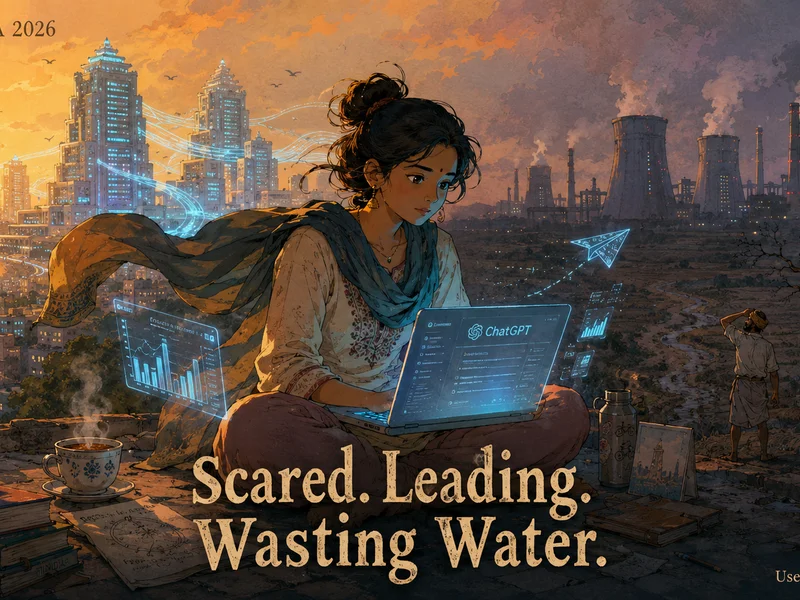
Here’s the thing about India and AI.
We are simultaneously ranked #1 and #101.
Not being dramatic. Anthropic published their India Country Brief earlier this year. The data is genuinely interesting.
India is the #2 country in total Claude AI usage globally. Right behind the US.
But per capita — adjusting for our working-age population — India ranks 101st out of 116 nations.
Those two things shouldn’t both be true. Except they are.
And that gap is exactly the thing worth understanding.
Okay, So Where Does India Actually Stand With AI?
India is the world’s #2 user of Claude AI and ranks #1 globally in AI use for software tasks at 45.2%. But per capita, India sits 101st out of 116 nations — meaning total usage is large because of population size, not because the average Indian is heavily using AI. Indian users who do use AI get a 15x productivity speedup, compared to 12x globally. The opportunity is real but narrow.
The Numbers That Most Headlines Are Getting Wrong
Time for my classic data paragraph. Bear with me.
The Anthropic Economic Index published a full India brief in February 2026, based on roughly a million Claude.ai conversations globally during November 2025.
Some things they found:
India ranks #1 globally in software-related AI task usage. 45.2% of all Indian Claude use maps to software occupations. Vietnam is #2. Egypt is #3. We are leading.
Indian users take an average of 14.8 minutes to do tasks that would otherwise take 3.8 hours. That’s a 15x speedup. The global average is 12x. Meaning when Indians use AI, they’re applying it to harder problems and getting more out of it.
51.3% of Indian Claude usage is work-related. Only 27.8% is personal. The global average for personal use is 34.7%.
We are using AI for work more than the world average. By a meaningful margin.
And enterprise AI adoption? India is at 80%. The US is at 59%.
India is the world’s most aggressive enterprise AI adopter — outpacing the US by 21 percentage points, at a lower GDP per capita.
Yuh. Seriously.
But Here’s the Part That Should Give You Pause
All those numbers sound incredible. And they are.
But here’s the catch.
The 80% enterprise adoption? 74% of it is in BFSI, IT services, and telecom. Heavily concentrated.
The total Claude usage that makes us #2 globally? Over half of it comes from just four states: Maharashtra, Tamil Nadu, Karnataka, and Delhi.
Four states. Out of 28.
Per capita, adjusted for our massive population, India sits 101st out of 116 countries in Claude usage. That number reflects what the Anthropic team actually said: India’s high absolute usage reflects population size — not that the average Indian is heavily using AI.
The people who are crushing it with AI in India are in GCCs, IT companies, top-tier universities.
Everyone else is — honestly — either making Ghibli portraits or mildly scared of the whole thing.
The 14% figure is worth noting here. Data shows a meaningfully higher percentage of Indians express hesitation or anxiety about AI products compared to peer countries. On the flip side, among working professionals who use AI regularly? India leads the usage-intensity charts.
Split personality. Exactly.
Wait, I Need to Talk About the Ghibli Thing
I’m going here because nobody else is.
Earlier this year, ChatGPT’s image model went viral. Everyone made Studio Ghibli-style portraits. Including me. I made multiple. I posted them on Twitter. People asked me to make theirs. I made those too.
It was fun. I’m not saying it wasn’t.
But every single one of those images required backend computation that you can’t see. GPU clusters running at full load. Data centers processing millions of simultaneous requests. And to run those data centers at that scale?
They need electricity. A lot of it.
And to keep those GPUs from literally overheating and melting down?
They need water. A shocking, uncomfortable amount of water.
One large Meta data center uses up to 500,000 gallons of water per day. Drink-quality, clean water that goes in, heats up, gets vented out. Rinse and repeat, forever.
The Stanford AI Index 2026 dropped this number quietly:
Annual water use for GPT-4o inference alone could exceed the drinking water needs of 12 million people.
12 million people’s annual drinking water. For one model’s inference.
And AI data center power capacity globally has hit 29.6 gigawatts — comparable to the entire state of New York at peak demand.
The Business Insider investigation on US data centers found neighborhoods in Northern Virginia where electricity bills doubled, drinking water depleted, constant hum vibrating people’s walls at night, families moving to basements with noise-cancelling headphones just to sleep.
One resident near Amazon’s data center cluster said her 7-year-old son kept waking up from nightmares thinking there was a spaceship outside.
That’s not clickbait. That’s a person’s life.
Now — India is about to get a lot more of these. Which brings me to Vizag.
The Visakhapatnam Story Is Huge (and Not Talked About Enough)
April 28, 2026.
Andhra Pradesh CM Chandrababu Naidu laid the foundation stone for Google’s ₹1.35 lakh crore AI hub in Visakhapatnam.
$15 billion. Google’s largest ever investment in India. One of the largest single FDIs in India’s history.
The specs:
- Initial capacity: 1 gigawatt
- Potential scale: 5 gigawatts
- Land: 600 acres across three campuses
- Partners: Adani ConneX and Airtel Nxtra
- Three international subsea cables landing at Vizag — connecting India directly to the US, Europe, Africa, and Australia
For reference: India’s total national data center capacity was approximately 1.5 GW as of late 2025.
This one project could eventually be 3x all of India’s current capacity.
Union IT Minister Ashwini Vaishnaw said it. Visakhapatnam is being “reborn as AI Patnam.” Like how Hyderabad became Cyberabad in the 90s. That’s the ambition.
And honestly? I believe it. The strategic logic is real. Vizag sits on the eastern coast — proximity to Southeast Asia, Australia, the emerging digital demand centers of the world. The subsea cable gateway is genuinely significant for India’s digital sovereignty.
But.
A 5 GW facility needs power. It needs water. Lots of both.
The environmental questions that are currently destroying neighborhoods in Virginia, draining aquifers in Arizona, doubling electricity bills in Nebraska — those questions are coming here.
We need to build the infrastructure and ask the questions at the same time. Not infrastructure first, questions never.
Will AI Take Your Job? Actually Answering This
No more “it depends.” Let me just say the thing.
Per the Anthropic labor market report: computer programmers have a 74.5% AI exposure rate. Customer service representatives are heavily exposed. Data entry, financial analysis, admin work — all high. Call centers? You’ve already seen it — you call Jio or Airtel and you’re talking to AI, not a person.
The Stanford AI Index 2026 — published April 2026 — gives us the first hard labor data:
Entry-level software developer jobs for workers aged 22–25 fell nearly 20% since 2024.
This is the first white-collar job category with a measurable hiring contraction directly attributable to AI. And the trend is accelerating.
So yes. It’s happening.
But here’s the nuance that gets lost:
Productivity for people who kept their jobs went up. Marketing teams using AI show productivity gains up to 72%. Software developers up 14-26%. Customer support up 14-26%.
The math is simple and brutal. If what used to take 8 hours now takes 4 hours — your company doesn’t send you home early. They give you more work. Or they hire half as many people for the same output.
Companies don’t exist to give people jobs. They exist to make money with as few inputs as possible. AI made one major input — human labor — cheaper and faster.
Cognizant announced potential impacts to 7,000–15,000 employees in one news cycle. It’s not hypothetical anymore.
My honest take: the people who will be fine aren’t the ones avoiding AI. They’re the ones who use it so well they become irreplaceable.
Ground maintenance? Still needs humans. Courtroom lawyering? Still needs humans. Surgery? Still needs humans.
But if your job is mostly information processing — writing documents, debugging code, answering queries, analyzing data — AI is already doing a version of that better than a freshly hired grad.
The question is which side of that you’re on.
So Use AI Smartly, Man
I know this sounds simple as I’m writing it.
But the data literally proves it.
The longer you use AI — and the better you get at prompting, refining, iterating — the more value you extract. The Anthropic data shows high-tenure users get significantly better task success rates. The tool improves for you as you improve with it.
ChatGPT and Perplexity usage in India is among the highest in the world. Indian students are near the top globally for AI tool adoption in coursework. We have the second-largest AI talent pool on the planet.
The infrastructure is coming. The $67 billion that Microsoft, Amazon, and Google committed to India? It lands. The IndiaAI Mission’s 38,000 GPUs — already exceeded the target. GPU compute in India costs 40-50% less than the global average.
The only variable left is you.
Not building a data center. Not deploying an agentic workflow. Just — learning to use the tool properly. Getting good at it. Using it for actual work, not just for making your face look like a Studio Ghibli character.
I’m not saying Ghibli was wrong. I made multiple. They were nice.
I’m saying: also use it for the thing that’s going to matter in two years.
FAQ
Will AI replace jobs in India? It already has in some roles. Entry-level developer hiring fell ~20% globally since 2024. Call center and data entry roles face high exposure. Jobs requiring judgment, physical presence, or complex human relationships are safer. The bigger risk is not adapting — and watching others who do adapt become more competitive than you.
Which jobs in India are safe from AI? Ground maintenance, healthcare requiring hands-on judgment, courtroom legal work, and physical trades are lower risk currently. Any job that’s primarily information processing, document creation, or routine customer interaction faces high exposure. Check the Anthropic labor report — field-by-field breakdown is public.
Is India really #1 in AI adoption? Indian enterprise adoption leads the world at 80% vs the US at 59%. But per-capita individual usage ranks 101st out of 116 countries. It’s concentrated in four states and in IT services. Both things are true. We lead in intensity; we’re average in spread.
What’s actually happening in Visakhapatnam? Google broke ground on April 28, 2026 for a $15B AI hub — India’s first gigawatt-scale data center. Initial 1 GW capacity, potential 5 GW. Three subsea cables connecting Vizag to the US, Europe, Africa, and Australia. Target commissioning: July 2028. It’s genuinely significant.
What’s the environmental cost of AI? Significant and underreported. Data centers need massive electricity and clean water for GPU cooling. The Stanford AI Index 2026 says GPT-4o inference water use alone could exceed 12 million people’s annual drinking water needs. Global AI data center power has hit 29.6 GW. These costs are real — and they’re coming to India too.
Anyway.
The data is out there. The reports are linked. The picture is not as simple as “AI superpower India” or “AI will destroy Indian IT.”
It’s weirder and more interesting than both.
Use it smartly. That’s it.
Chalo, bye.
PS: The next time you’re batch-generating Ghibli portraits for your entire contact list — maybe just make one. The GPU is tired. Kinda.
Comments
Related Articles


Never miss an update
Join 50,000+ developers getting our weekly tech insights.